
Food begging and fish stealing from anglers by a Little Egret (Egretta garzetta) in urban Japan
Abstract
I describe food-stealing and food-begging behavior by a Little Egret (Egretta garzetta) observed at an urban park in Yokohama, Japan, between 2022 and 2025. A single individually recognizable bird frequently associated with anglers and obtained fish either by receiving directly from them or by stealing from containers used to temporarily store catches. During approximately 10 hours of detailed observation period, the egret obtained 25 fish directly from anglers, stole 20 fish from containers, and captured 46 fish independently. The bird appeared to distinguish between anglers likely to provide food and those who did not. A review of Internet-based records revealed at least 23 similar cases in Japan. This behavior may represent a form of autolycism or feeding parasitism and appears to have become increasingly reported in recent decades. I discuss possible factors contributing to its occurrence.
Key words: autolycism, behavioral flexibility, feeding parasitism, kleptoparasitism.
Herons and egrets generally locate and capture fish either by standing motionless and waiting (stand-and-wait) or by walking slowly through shallow water (Kushlan 1976, Voisin 1991). Some species, however, exhibit unusual and intriguing foraging techniques. Representative examples include bait-fishing by the Striated Heron Butorides striata (Higuchi 1986, 1988a, b), foot-stirring by the Little Egret (Egretta garzetta) and Snowy Egret (E. thula) (Meyerriecks 1966, Kushlan 1976, Voisin 1991), bill-vibrating by the Little Egret, Black-crowned Night Heron (Nycticorax nycticorax), Cattle Egret (Bubulcus ibis), Snowy Egret, and Great Egret (Ardea alba) (Kushlan 1976, Voisin 1991, Kelly et al. 2003, Hamao et al. 2005), and the crouch-with-outstretched-wings of the Pacific Reef Heron (Egretta sacra) (Nakashima 2026).
In recent years, anecdotal reports posted on personal websites and social media platforms from Japan have described Little Egrets and Grey Herons (Ardea cinerea) that remain close to anglers, steal small fish from fish containers, or receive fish directly from anglers. Such behavior may be regarded as an example of autolycism (Thomson 1959), the use of other animals, including humans, for one’s own benefit. Because this behavior combines food begging and kleptoparasitism directed toward anglers, I refer to it here as “feeding parasitism”. Kleptoparasitism means deliberate behavior in which one animal steals food and materials from another (Brockmann and Barnard 1979).
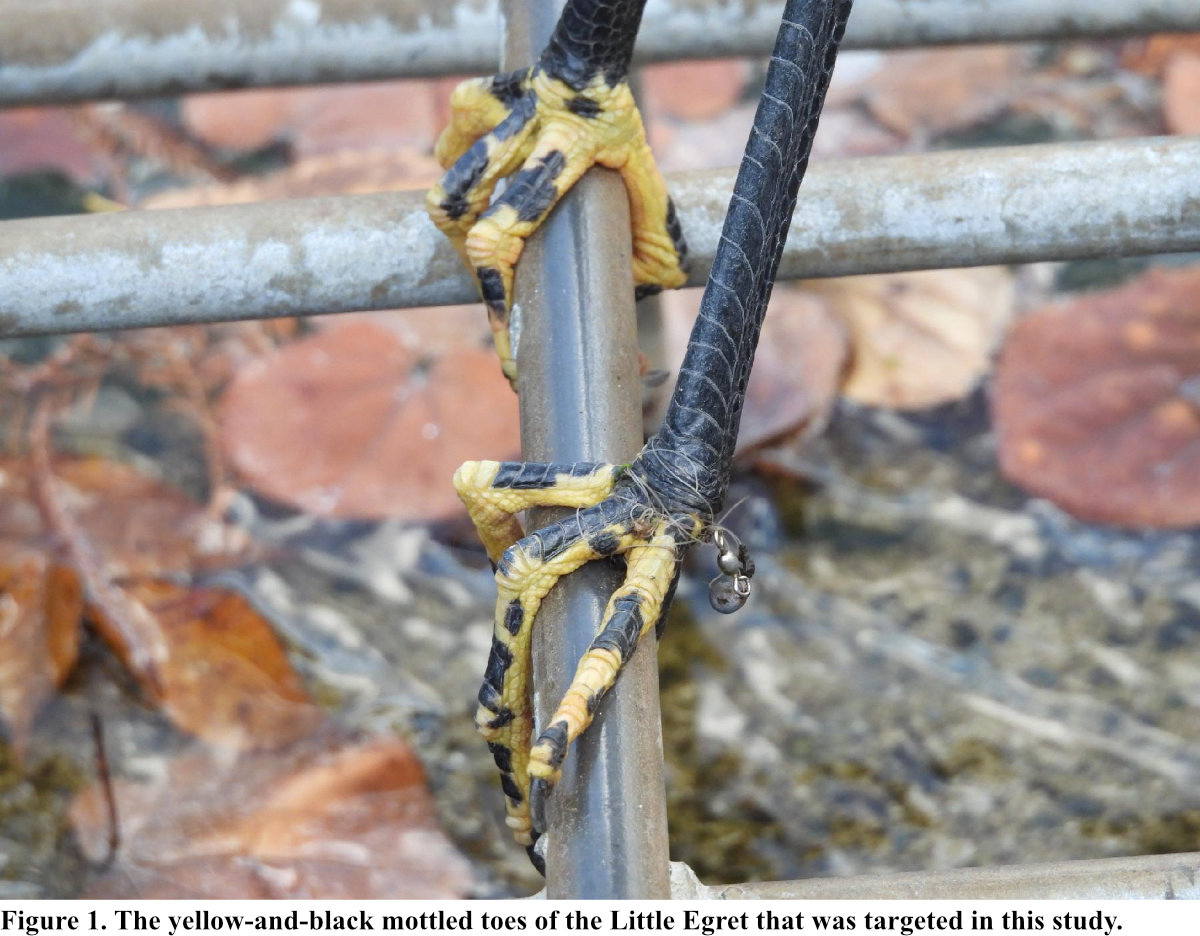
From March 2022 to April 2025, I intermittently observed a Little Egret exhibiting this behavior at Yamazaki Park in northern Yokohama, central Japan (35° 33′ 33.9″ N, 139° 34′ 13.8″ E), on 12 occasions, totaling 19.3 hours of observation. The park covers 67,340 m2 and contains a pond of approximately 1,630 m2 at its northeastern end. Although five Little Egrets were observed within the park and the surrounding 300 m area, only one resident individual in the pond engaged in feeding parasitism. The bird (sex unknown) was readily identifiable by its distinctive yellow-and-black mottled toes, unlike the uniformly yellow toes of typical individuals (Fig. 1). It showed little fear of humans, stayed close to anglers, peered into fish containers, and occasionally succeeded in taking small fish from them (Fig. 2). The fact that only one of at least five local Little Egrets exhibited this behavior suggests that it may be individually acquired rather than species-typical.
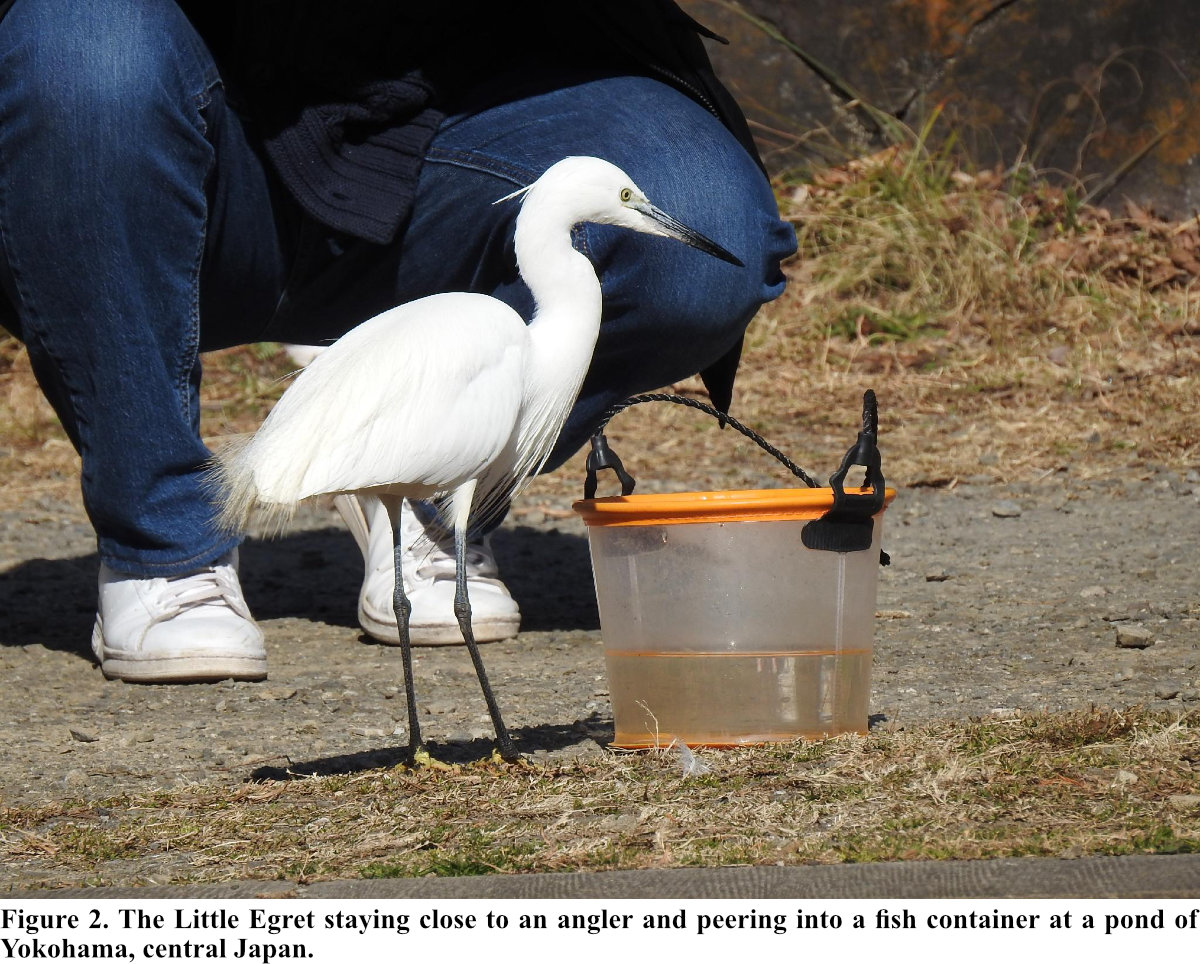
Fishing at this pond is basically restricted to catch-and-release. Target species include Japanese White Crucian Carp (Carassius cuvieri) (30-40 cm total length), Rosy Bitterling (Rhodeus ocellatus) (6-8 cm), and Stone Moroko (Pseudorasbora parva) (about 8 cm). Anglers differ in the species they target. Crucian carp are released immediately after capture, whereas some anglers temporarily keep bitterlings and stone moroko in containers before returning them to the pond at the end of the day to assess their catch. These containers provided opportunities for the egret to steal fish.
Some anglers, concerned about the egret that constantly accompanied them, occasionally offered it part of their catch. The fish provided were usually small species such as bitterlings and stone moroko. Only certain individuals appeared to feed the bird regularly. The egret appeared to recognize these individuals and often waited beside them. However, because even these anglers did not always provide fish, the egret would move to another person if no food was forthcoming for some time. The duration of its stay near a particular angler ranged from about 5 to 20 minutes and appeared to depend largely on the number of anglers present, especially those tolerant of the bird’s presence.
When fish obtained by stealing or begging were scarce, the egret foraged independently along the shoreline. For example, on 14 March 2022, when approximately 10-15 anglers were present, the bird received only five fish from anglers during a two-hour period between 15:00 and 17:00 hr. It then captured an additional 5-8 fish using techniques such as foot-stirring, after which it hunted by ambush in narrow channels or perched on metal railings above inflowing waterways and either captured prey from the perch or plunged into the water. This behavioral shift suggests considerable behavioral flexibility.
During approximately 10 hours of detailed observation period between early and late March 2022, the egret obtained 25 small fish directly from anglers, stole 20 fish from containers, and captured 46 fish on its own. The relative contribution of these feeding methods seemed to vary considerably depending on the type and number of anglers present. When a particularly “cooperative” angler remained for an extended period, the egret spent much of its time nearby and received many fish. Otherwise, it moved frequently from place to place, received few or no fish, and increasingly relied on independent foraging. The egret appeared to distinguish between anglers likely to provide food and those who did not. This suggests individual recognition of human behavior and the ability to associate specific human activities with food availability.
The egret showed no response when anglers landed Japanese White Crucian Carp nearby. During the study period, I observed approximately 60 such captures, none of which elicited any reaction from the bird. In contrast, whenever anglers caught small fish such as bitterlings, the egret quickly approached and attempted to obtain them. The egret appears to know that White Crucian Carp are not offered by anglers. It is therefore likely that the egret behaves in different ways, distinguishing between fish that might be offered and those that would not.
Although the behavior of Little Egrets stealing fish from containers or receiving fish directly from anglers has apparently not been documented in the scientific literature, at least 23 cases are known in Japan according to information available on the Internet (see Appendix 1). Records come from the localities of Sendai, Tokyo, Chiba, Yokohama, Aichi, Kyoto and Yamaguchi, with five cases reported from Mizumoto Park in Tokyo. The earliest observation dates from an unknown site in 2003. Nineteen records are from 2010 onward. At Yamazaki Park, the present study site, a similar observation was recorded in April 2015. Among reported habitats, ponds including managed fishing ponds account for 14 cases, rivers for seven, and channel and unknown for one each.
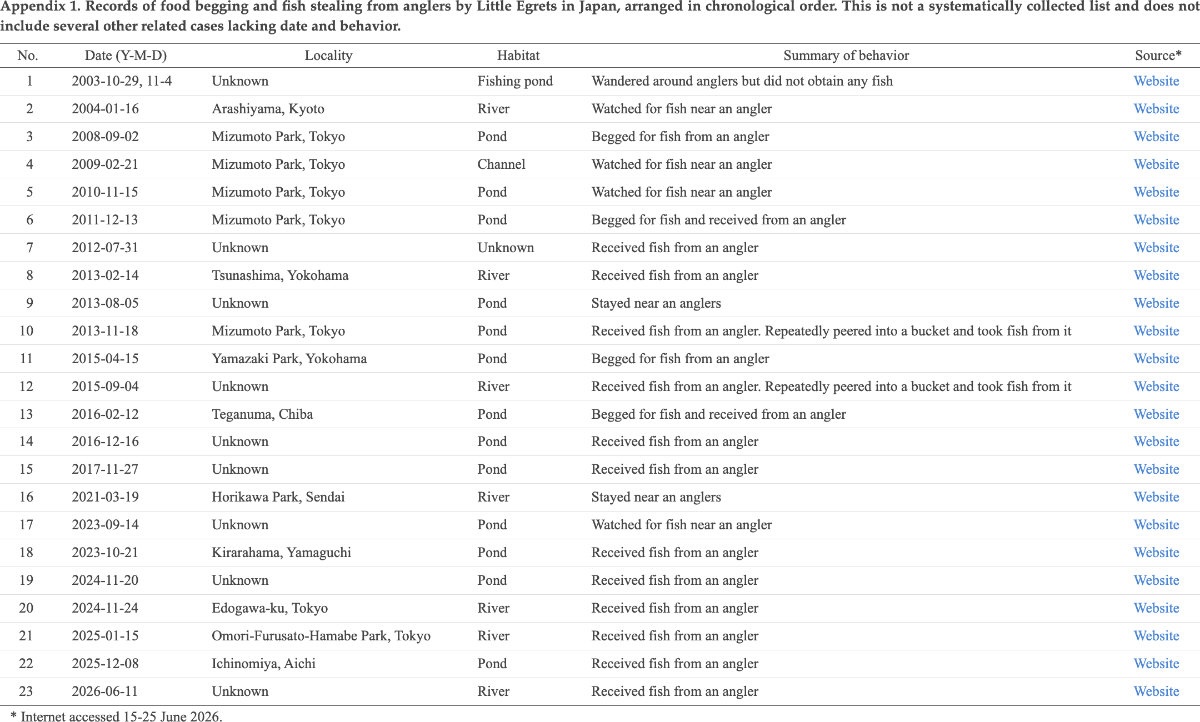
The reason for the predominance of observations since 2010 is not clear. It may reflect the widespread use of the Internet during the period, which facilitated the reporting of such behavior. However, Hamao et al. (2005), who extensively reviewed the foraging behavior of Japanese herons and egrets using both published literature and Internet sources, did not report fish-stealing or food-begging from anglers. This behavior may be associated with demographic changes in Japan, particularly the retirement of many members of the postwar baby-boom generation, who now spend substantial amounts of time fishing in local ponds and rivers. Indeed, many anglers at such sites are over 70 years old. Similar trends can be seen in people feeding Tree Sparrows (Passer montanus) in parks throughout Japan (Higuchi 2013). Both phenomena may be viewed as reflections of broader social changes in contemporary Japan. Further observations and statistical procedures are needed to clarify the relevant relations in this context.
Acknowledgements
I would like to thank Katsutoshi Matsunaga and Chip Weseloh for helpful comments on the earlier versions of the manuscript.
Literature Cited
- Brockmann, H. and C. Barnard. 1979. Kleptoparasitism in birds. Animal Behaviour 27: 487-514.
- Hamao, S., T. Ida, H. Watanabe and H. Higuchi. 2005. Prey attracting and disturbing behaviors in herons: bill-vibrating and other ingenious foraging techniques. Strix 23: 91-104.
- Higuchi, H. 1986. Bait-fishing by the Green-backed Heron Ardeola striata in Japan. Ibis 128: 285-290.
- Higuchi, H. 1988a. Individual differences in bait-fishing by the Green-backed Heron Ardeola striata associated with territory quality. Ibis 130: 39-44.
- Higuchi, H. 1988b. Bait-fishing by Green-backed Herons in south Florida. Florida Field Naturalist 16: 8-9.
- Higuchi, H. 2013. Tori hito shizen: Inochi no nigiwai o motomete (Birds, humans, and nature: Celebrating the diversity of life). University of Tokyo Press.
- Kelly, J. F., D. E. Gawlik and D. K. Kieckbusch. 2003. An updated account of wading bird foraging behavior. Wilson Bulletin 115: 105-107.
- Kushlan, J. A. 1976. Feeding behavior of North American herons. Auk 93: 86-94.
- Meyerriecks, A. J. 1966. Additional observations on foot-stirring “Feeding Behavior in Herons”. Auk 83: 471-472.
- Nakashima, S. 2026. Foraging behavior and habitat use of dark morphs of the Pacific Heron Egretta sacra: The “Crouch with outstretched wings” foraging technique. Strix 42: 23-38.
- Thomson, L. 1959. Birds of prey. Nature 184: 1435-1436.
- Voisin, C. 1991. The herons of Europe. T and AD Poyser.