Use of natural cover by a Snowy Egret (Egretta thula) when hunting prey
Abstract
The use of natural cover by predators to reduce detection and ambush distance is known among multiple taxa including marine and terrestrial mammals, snakes, and raptors. Here we report on a previously undescribed foraging behavior by the Snowy Egret (Egretta thula) that we term Use of Natural Cover. Over a 1 min 14 sec video-recorded feeding bout, we documented the Snowy Egret’s use of natural cover to reduce detection by prey and ambush distance. The Snowy Egret has the broadest behavioral foraging repertoire of any heron. However, its foraging efficiency is low in comparison to other heron species. We speculate that the Use of Natural Cover as a foraging behavior by the Snowy Egret may possibly be related to its broad behavioral foraging flexibility and/or its necessity to incorporate multiple foraging activities to meet its daily energy requirements.
Key words: decrease ambush distance, foraging behavior, reduce detection by prey, Snowy Egret, Use of Natural Cover.
Introduction
Many predators including marine (Heithaus and Dill 2009 and terrestrial mammals (Kleiman and Eisenberg 1973, Eads et al.. 2012), snakes (Hanscom et al.. 2023), and raptors (Cresswell and Quinn 2010, Buij 2012) use natural cover when hunting to reduce their detection by prey and to decrease the ambush distance, thereby enhancing hunting success.
The Snowy Egret has the broadest behavioral foraging repertoire, 31 of the approximate 36 described behaviors for all herons (Kushlan 1978, Hancock and Kushlan 1984, Kelly et al.. 2003, Parsons and Master 2020, Nisbet 2024, Sneegas and Newmark 2024). However, Use of Natural Cover to reduce detection by prey and to decrease ambush distance has not been previously reported in the Snowy Egret.
Here we describe a one-minute video-recorded foraging bout by a Snowy Egret that incorporated six foraging behaviors including Walking Slowly, Walking Quickly, Running, Wing Flicking, Head Tilting and a previously undescribed foraging behavior in the Snowy Egret – Use of Natural Cover.
Methods
On 21 September 2024, GWS observed and video-recorded an adult Snowy Egret over a 1 min 14 sec feeding bout at Clinton Lake, Douglas County, Kansas, U.S.A., in the Bloomington Public Use Area east ramp 7 (95° 22′ 07.1″ W, 38° 54′ 38.2″ N). The bird was observed and video-recorded from a distance of 155 m, measured with a range finder, using an 800 mm lens. The dimensions of the rock that the Snowy Egret used as natural cover were measured in the field. Mean turbidity of water at 0.3 m in depth in Clinton Lake in September 2024 was 12.5 NTU, i.e., slightly cloudy (United States Army Corps of Engineers 2024). Mean summer chlorophyll concentrations between 2013-2022 were classified as moderate or mesotrophic (United States Army Corps of Engineers 2022).
Definitions of previously-defined foraging behaviors that were observed during the 1 min 14 sec feeding bout follows Kushlan (1978) - Wing Flicking quickly partially extends wings; Rodgers (1983) - Walking Slowly ≤1 step/sec; Walking Quickly >1≤ 2 steps/sec; Running >2 steps/sec; and Meyerriecks (1962) - Head Tilting head and neck extended sharply to one side of the main body axis. The duration of these five foraging behaviors and the foraging behavior described here – Use of Nature Cover – were extracted from the video file. The sum of the duration of the individual foraging behaviors exceed 1 min and 14 sec because two or more foraging behaviors were simultaneously observed on several occasions over the recorded feeding bout.
Observation
Initial observations. The Snowy Egret was initially observed at 09:16 hr walking slowly in a westerly direction ~ 0.5 m from the shore line in water with a depth of 5 - 10 cm (Video 1). During the observed 1 min 14 sec feeding bout the Snowy Egret repeatedly pursued and on at least two occasions captured gizzard shad (Dorosoma cepedianum), ~3 - 7 cm in length, a common freshwater fish that often schools in shallow waters in ponds and lakes in eastern Kansas (Cross and Collins 1995).
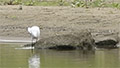
Use of Natural Cover. At 39 sec into the recorded feeding bout, the Snowy Egret that was foraging parallel to shoreline in a westerly direction approached three emergent rocks. The Snowy Egret took cover behind the most northerly-located rock, which was triangular in shape from a lateral perspective and ranged in height from 27 cm above the lake bottom at the approaching anterior end to 38 cm above the lake bottom at the posterior end and was 55 cm in length.
The Snowy Egret positioned itself behind the approaching anterior edge of the most northerly-located rock and stopped. The egret then bent forward in a northerly direction and peered around the corner of rock in a westerly direction searching for prey along the lateral edge of the rock. The egret apparently did not observe any prey along the lateral side of the rock. The egret then Walking Slowly in a crouched position around the corner of the northerly-located rock turned in a westerly direction along the lateral side of the rock and stopped briefly before it assumed an upright posture. The egret then began Walking Quickly along the lateral side of the rock until it reached the posterior end of the rock when it suddenly turned in a southerly direction and struck for prey along the posterior edge of the rock. It was not possible to determine from the video clip whether the egret was successful in this strike in capturing prey along the posterior edge of the rock.
Subsequent observations. Following the ambushing of prey from behind the northerly-located rock, the Snowy Egret proceeded to forage along the shoreline of Clinton Lake in a westerly direction and during the last 23 sec of the recorded feeding bout incorporated five previously described foraging behaviors. These included Walking Slowly, Walking Quickly, Running, Head Tilting, and Wing Flicking while pursuing gizzard shad that were swimming in front of the egret in shallow water. The egret was successful in striking and capturing one or more of the gizzard shad during the last 23 sec of the recorded feeding bout. The total distance that the egret covered over the 74 sec. foraging bout was 12.7 m using the length of the rock (55 cm) that the Snowy Egret used as natural cover, and which was measured in the field, as a scale in the video.
Duration of foraging behaviors. Six foraging behaviors were recorded over the 1 min 14 sec feeding bout which included Walking Slowly for 22 sec, Walking Quickly for 18 sec, Running for 7 sec, Head Tilting for 24 sec, Wing Flicking for 9 sec and Use of Natural Cover for 11 sec.
Discussion
The Use of Natural Cover by the Snowy Egret is very likely an uncommon foraging behavior. This is a result of several factors. Firstly, objects that can serve as natural cover such as rocks, logs, or clumps of vegetation must be positioned within the foraging habitat of the Snowy Egret, which is open shoreline along shallow water bodies (Parsons and Master 2020); and secondly, objects that the Snowy Egret can use as natural cover must be of adequate size − neither too large nor too small − to allow the egret to both hide behind as well as observe and ambush potential prey. These conditions we believe are uncommon.
Could there, however, be an alternative explanation(s) for this observed foraging behavior? It should be noted that immediately prior to the Snowy Egret positioning itself behind the rock it was Head Tilting. Head Tilting in herons and egrets is a foraging behavior that is thought to reduce glare from the water (Meyerriecks 1962, Krebs and Partridge 1973, Hancock and Kushlan 1984). Was it possible that ambushing prey was not the primary intent of the Snowy Egret but rather the egret had no choice but to move behind the rock in order to continue Head Tilting? However, given that the Snowy Egret stopped briefly behind the rock and then crouched and peered around its lateral side strongly suggests that the primary purpose of the Snowy Egret stopping behind the rock was to reduce its detection by prey and to decrease the ambush distance rather than to reduce glare from the water. A crouched posture in egrets has been previously associated with concealment, stalking, and in preparation to strike (Kushlan 2011). Indeed, as soon as the Snowy Egret reached the posterior end of the rock it suddenly turned and struck for prey along the posterior edge of the rock. It should also be noted that fish use both visual as well as mechano-acoustic cues to detect predators (Katzir and Camhi 1993, Lukas et al.. 2021), and thus the Snowy Egret’s use of natural cover would be an effective strategy to reduce detection by fish as well as ambush distance.
An additional alternative explanation for the observed foraging behavior may possibly be Standing - the most common foraging behavior among herons and egrets (Hancock and Kushlan 1984). However, our observation differs from Standing as defined by Hancock and Kushlan (1984) which is “the bird waits for a potential prey item to appear and strikes at it.” In our observation, after stopping behind the rock the Snowy Egret stood erect, i.e., Standing after waiting for one second behind the rock before bending forward in a crouched position and peering around the corner of the rock. The Snowy Egret then proceeded to Walk Slowly along the lateral edge of the rock of the rock before Walking Quickly and then suddenly turning and striking, i.e., ambushing prey along the posterior end of the rock. Standing as defined by Hancock and Kushlan (1984) was not what we observed and video-recorded.
The Snowy Egret has the broadest behavioral foraging repertoire of any heron. And hence we speculate that the Snowy Egret’s ability to Use Natural Cover to reduce detection and ambush distance may be facilitated by its behavioral flexibility. At the same time, the foraging efficiency of the Snowy Egret has also been found to be low, at least locally, in comparison to two other congeneric species. In Old Tampa Bay and Safety Harbor in Florida, the Snowy Egret was found to forage twice as long per day in comparison to the Tricolor Heron (Egretta tricolor) or Little Blue Heron (Egretta caerulea) (Kent 1986). Thus, the Use of Natural Cover by the Snowy Egret could also be related to its necessity to incorporate multiple foraging strategies in order to meet its daily energy requirements (Kent 1986), although a relationship between daily energy requirements and behavioral foraging flexibility has not been assessed as far as we are aware.
Finally, it should be noted that the Use of Natural Cover is a foraging behavior known among other bird species. The best evidence comes from studies of raptors. The Pallid Harrier (Circus macrourus) in the northern Sahel in Africa have been observed to follow edges of bushland and agricultural fields when hunting small passerines as well as to crouch in vegetation close to the ground before mounting an attack (Buij 2012). Crouching and waiting behind vegetation has also been described in Mongolia in the Steppe Eagle (Aquila nipalensis) when hunting ground squirrels (Tingay et al.. 2008). In Scotland, it has been documented that the sparrowhawk (Accipiter nisus) and peregrine falcon (Falco peregrinus) use dense wood, bushes and a creek lower than the surrounding area when hunting flocks of redshanks (Tringa totanus) (Cresswell and Quinn 2010). Crouching and Use of Natural Cover to reduce detection and ambush distance of prey by both the Snowy Egret and as well as the Pallid Harrier and Steppe Eagle strongly suggest that Use of Natural Cover is a foraging behavior that has evolved independently in Ciconiformes and Accipitriformes.
Our observation and video-recording provide supporting evidence for a previously undescribed form of foraging behavior – Use of Natural Cover – in the Snowy Egret. However, additional field observations would be valuable in confirming this presumably uncommon foraging behavior.
Acknowledgements
We thank M. Sneegas for his assistance in the field.Literature Cited
- Buij, R. 2012. Pallid Harrier Circus macrourus bird hunting behaviour and capture success in northern Cameroon. Ostrich 83: 27-32.
- Cresswell, W. and J. L. Quinn. 2010. Attack frequency, attack success and choice of prey group size for two predators with contrasting hunting strategies. Animal Behaviour 80: 643-648.
- Cross, F. B. and J. T. Collins. 1995. Fishes in Kansas. 2nd edition. University of Kansas Press.
- Eads, D. A., M. T. J. Hague and C. G. Zoubek. 2012. American badger (Taxidea taxus) uses covert reconnaissance to ambush a black-tailed prairie dog (Cynomys ludovicianus). Southwestern Naturalist 57: 463-464.
- Hancock, J. and J. Kushlan. 1984. The herons handbook. Harper and Row.
- Hanscom, R. J., T. E. Higham, D. S. Ryan and R. W. Clark. 2023. Ambush hunting in snakes: Behavior, function, and diversity. Pages 279-311 in Snakes: Morphology, Function, and Ecology. Nova Science Publishers.
- Heithaus, M. R. and L. M. Dill. 2009. Feeding strategies and tactics. Pages 414-423 in Encyclopedia of Marine Mammals (Second Editon) (W. F. Perrin, B.Würsig and J. G. M. Thewissen, eds.). Academic Press.
- Katzir, G. and J. M. Camhi. 1993. Escape response of Black Mollies (Poecilia sphenops) to predatory dives of a Pied Kingfisher (Ceryle rudis). Copeia 1993: 549-553.
- Kelly, J. F., D. E. Gawlik and D. K. Kieckbusch. 2003. An updated account of wading bird foraging behavior. Wilson Bulletin 115: 105-107.
- Kent, D. M. 1986. Foraging efficiency of sympatric egrets. Colonial Waterbirds 9: 81-85.
- Kleiman, D. G. and J. Eisenberg. 1973. Comparisons of canid and felid social systems from an evolutionary perspective. Animal Behavior 21: 637-659.
- Krebs, J. C. and B. Partridge 1973. Significance of head tilting in the Great Blue Heron. Nature 242: 533-535.
- Kushlan, J.A. 1978. Feeding ecology of wading birds. Pages 249-296 in Wading birds (A. J. Sprunt, J. Ogden and S. Winckler, eds.). National Audubon Society.
- Kushlan, J. A. 2011. The terminology of courtship, nesting, feeding and maintenance in herons. [online].
- Lukas, J., P. Romanczuk, H. Klenz, P. Klamser, L. A. Rodrigues, J. Krause and D. Bierbach. 2021. Acoustic and visual stimuli combined promote stronger responses to aerial predation in fish. Behavioral Ecology 32: 1094-1102.
- Meyerriecks, A. J. 1962. Diversity typifies heron feeding. Natural History 71: 48-59.
- Nisbet, I. C. T. 2024. Tongue-fluttering by Snowy Egrets (Egretta thula) foraging in a tidal estuary. Waterbirds 47: 1-6.
- Parsons, K. C. and T. L. Master. 2020. Snowy Egret (Egretta thula), version 1.0. in Birds of the World (A. F. Poole and F. B. Gill, Editors). Cornell Lab of Ornithology. [online].
- Rodgers, J. A., Jr. 1983. Foraging behavior of seven species of herons in Tampa Bay, Florida. Colonial Waterbirds 6: 11-23.
- Sneegas, G. W. and W. D. Newmark. 2024. Flush-pursuit foraging behavior by a Great Egret (Ardea alba). Journal of Heron Biology and Conservation 9: 2. [online].
- Tingay, R. E., N. Sureda and M. Gilbert. 2008. Steppe Eagle (Aquila nipalensis) foraging behavior in Mongolia: A combined use of diversionary and covert ambush tactics. Journal of Raptor Research 42: 155-156.
- United States Army Corps of Engineers. 2022. [2022] Clinton Lake water quality data. Kansas City District. [online].
- United States Army Corps of Engineers. 2024. [2024] Clinton Lake water quality data. Kansas City District. [online].